Our next destination is the complex of Tirki Jandiy. With our teacher Dilnoza Ilhomovna and two groups , we have visited to the memorial complex on Monday. This unrestored mausoleum lies just south of the city's main tourist zone, on the east side of Nomozgokh Street which leads eventually to the Namazgah Mosque. The exact age of the structure is uncertain, but Badr and Tupev note that unpublished excavation reports from 1971-72 suggest the current edifice was constructed in the mid-16th century, with evidence of three other building periods, two earlier and one later. From an architectural perspective the building's prominent dome set upon a tall drum is indicative of Timurid-era architecture and recalls the Mir-i-Arab Madrassa (likely a contemporary structure) and the far earlier Gur-e-Amir Mausoleum in Samarkand (c. 1403-04). The interior of the mausoleum is unfortunately off-limits to visitors due to its poor structural condition—the main dome is cracked and may be...
Hi,hi,hi.What's up?😉 Today is Wednesday, the eighth day of our practice session. We have visited to Toqi Zargaron. The Tak-i Zargaron is a multiple dome-covered market located at the intersection of the primary east-west and north-south streets of Bukhara's center city (Shahristan). The largest and best preserved of Bukhara's once numerous crossroad markets (chorsu), its name translates to "The Dome of Jewelers or Goldsmiths", which conflicts with its traditional function as a textile market. Although no single patron or inaugural date is recorded, passages in Arab historian Zain- ud Din Wofisi's (1485-1551) 'Badaye' al-Vaqaye' suggest an early sixteenth century date under Timurid instead of the popularly believed Shaybanid patronage. Domed crossroad markets were popularly called "Taks" (arch) referring to their characteristic vaulted shell structures. The pivotal role of "tak"s in sustaining Bukhara's eminence among Silk...
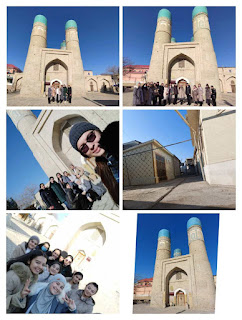
Hi,our trip is going on with glandeur places. Chor Minor ( Char Minar Uzbek : Chor minor ), alternatively known as the Madrasah of Khalif Niyaz-kul , is a historic gatehouse for a now-destroyed madrasa in the historic city of Bukhara , Uzbekistan . It is located in a lane northeast of the Lyab-i Hauz complex. It is protected as a cultural heritage monument, and also it is a part of the World Heritage Site Historic Centre of Bukhara . [1] In Persian , the name of the monument means "four minarets", referring to the building's four towers. Chor Minor


Comments
Post a Comment