Posts

Sayyid Amir Kulol

Image
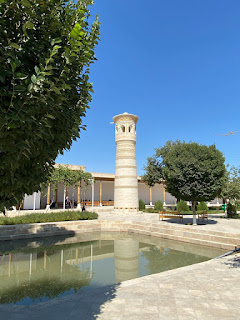
Ooo, yeah. Let's get started, buddy. ☺☺☺  Khuja Sayid Kulol Bukhariy was a prominent Sufi saint and spiritual leader in Bukhara, Uzbekistan. He was born in 1284 CE and spent most of his life teaching and spreading his spiritual teachings throughout Central Asia. He was a disciple of Khwaja Mahmoud Anjir Fagnawi, who was a prominent Sufi saint of his time. Khuja Sayid Kulol Bukhara emphasized the importance of following the Shariah (Islamic law) and encouraged his followers to focus on inner purification and spiritual development through prayer, meditation, and self-discipline. He is considered one of the most important figures in the history of Sufism in Central Asia. His tomb is located in Bukhara and is considered a holy site for pilgrims.

Fagnaviy

Image
"LIFE IS BEAUTIFUL,IF YOU KNOW HOW TO LIVE" Right, my dear? πŸ’«πŸ’«πŸ’«πŸ’«πŸ’«πŸ’₯πŸ’₯πŸ’₯😁πŸ’₯   We went there with our teacher Sitora Lutfulloyevna and learned its history Let's speak about himselfπŸ—’ Khoja Mahmud Anjir Fag'navi [end of 12th century - village of Anjir Fag'nav (q.v. Anjirbog), Vobkent district - 1286] - Khojagon is a great representative of the Naqshbandi order, the third of the 7 pirs of Bukhara. He was engaged in plastering. Khoja Arif Mohitoban studied under Revgariya and after his death he managed the series of khogagan. In "Silsilai Sharif" it is the 12 rings. He followed Hufiyna (hidden) Zikr and Jahriya (loud) Zikr equally. He mentored Khoja Ali Romitani (Khojai Azizon). Fagnavi was buried in his native village. The mausoleum above his grave was repaired during the period of independence, and a pool and a mosque were built next to the mausoleum. This place is now converted into a shrine. They were born in the beginning of the 13th century in Anj...

Romitaniy

Image
 Hey, I'm Ms Guli. Are you ready? Go on πŸ’«πŸ’ŸπŸ’«πŸ’«πŸ’« Today we visited  to the monument of Khoja Ali Romitaniy.It was new place for us to visit It was the forth one of 7 pirs. Now I'll share my impressions and photos of the buildingπŸ•Œ Let's speak about Khoja Ali Romitaniy himselfπŸ“ Romitani Khoja Ali, Khojai Azizon (middle of the 13th century - Kurgan village, Romitan district - 1316/1321) - a representative of the Khojagonnaqshbandiya sect. She was engaged in weaving. He lived in Khorezm for a while, opened a house and spread the economy in this area. His teacher on the path of Sufiism is Mahmud Anjirfagnavi. In turn, Romitaniy Khoja Muhammad Babayi Samosiynm is considered a teacher. The work "Manoqibi Khoja Ali Azizon Romitani" has reached us.

Samosiy

Image
Yeah, it's me. Let's get started. ☺☺☺☺☺   Today we shall learn about Khoja Muhammad Boboyi Samosiy✨ It was the fifth historical building of 7 pirs.It was located in Romitan. Samosiy , Khoja Muhammad Babayi Samosiy (end of 13th century, village of Samos in Romitan district - 1354) is a great figure of Khojagon-Naqshbandiya order, the fifth of the 7 pirs of Bukhara. He studied under Khoja Ali Romitani and after his death he led the Khojagan sect. When Bahauddin Naqshband was born, he adopted him as a spiritual child and assigned Sayyid Mir Kulol to take care of Bahauddin's upbringing. S. made a living by gardening. S. presented his helmet to Bahoudin and became a murshid to him. It is said that Bahauddin Naqshband was blessed with this hat. S. was buried in his native village. The mausoleum above his grave, the surrounding mosque and stone well were renovated during the years of independence.

Revgariy

Image
Hi, hi, hi. ☺   Khwaja Muhammad Arif ar-Revgari quddisu sirrihu was also known as Khwaja Arif Mohitaban. Khoja Arif was born in the village of Revgar, Shafirkon district of Bukhara region, he lived for more than a hundred years and died in 1259. His grave was turned into a prosperous shrine in the center of Shafirkon. In 1996, Khoja Arif mosque was built.  It is said that Khoja Arif was a man of medium height, fair face, big eyes, arched eyebrows, smelling of musk from his body.  Khoja Arif is the fourth caliph of Hazrat Abdulkhaliq Gijduvani. According to Hazrat Makhdumi Azam Dahbedi's work "Maqamoti Khoja Abdulkhaliq Gijduvani", Hazrat Khizr, peace be upon him, used to come to Hazrat Abdulkhalik.

Bakhouddin Nakshband

Image
Hi everyone, ☺πŸ‘­  Bakhouddin Nakshband was a prominent Sufi saint and the founder of the Nakshbandi order of Sufism in Bukhara, which became one of the most influential Sufi orders in the Islamic world. He was born in 1318 CE in Kasri Arifan, a village near Bukhara, and spent most of his life teaching and spreading his spiritual teachings throughout Central Asia and beyond. He emphasized the importance of following the Shariah (Islamic law) and encouraged his followers to focus on inner purification and spiritual development through prayer, meditation, and self-discipline. Bakhouddin Nakshband's tomb is located in Bukhara and is considered a holy site for pilgrims.

Gijduvoniy

Image
 Abdukhalik Gijduvoniy was a prominent poet and philosopher who lived in Bukhara, a city located in present-day Uzbekistan, during the 16th century. He was born in the village of Gijduvan near Bukhara and received his education in the city's madrasas (Islamic schools).  Gijduvoniy was known for his contributions to Sufism, a mystical branch of Islam, and his poetry often reflected his spiritual beliefs. He wrote in both Persian and Chagatai, a Turkic language spoken in Central Asia during that time. One of Gijduvoniy's most famous works is "Futuhat-i Makkiya" (The Meccan Revelations), a collection of his philosophical and spiritual writings. This work was later translated into Turkish, Arabic, and Urdu. Gijduvoniy was also known for his close relationship with the Mughal emperor Akbar, who invited him to his court in India. However, Gijduvoniy declined the offer and chose to remain in Bukhara. Today, Gijduvoniy is considered one of the greatest poets and thinkers of C...

Chor Bakr complex

Image
 πŸ˜Ž☺πŸ‘­πŸ‘‹ Dear Diary, Today was an exciting day as my coursemates and I went on a trip to the Chor Bakr complex in Bukhara. We woke up early in the morning and had a quick breakfast before heading out to explore this beautiful city. As we arrived at the Chor Bakr complex, we were struck by its grandeur and beauty. The complex is a collection of mausoleums and tombs, which were built in honor of the descendants of Abu Bakr, the first caliph of Islam. We were greeted by our tour guide who gave us a brief history of the complex. He explained that the Chor Bakr complex was built in the 16th century and is considered one of the most important pilgrimage sites in Central Asia. As we walked through the complex, we were amazed by the intricate designs and beautiful architecture. The buildings were adorned with colorful tiles and intricate patterns, which added to the charm of the place. We also visited the mosque located within the complex, which was equally impressive. The mosque had a lar...

Modarikhan

Image
 Hey, how is going?☺☺ Bukhara is a city in Uzbekistan, located on the Silk Road, which was an ancient trade route connecting China and the Mediterranean. Bukhara is known for its well-preserved historic center, which has been designated a UNESCO World Heritage site. The city has many notable landmarks, including the Kalyan Minaret, the Ark of Bukhara, and the Po-i-Kalyan complex. Bukhara also has a rich cultural heritage, with a long history of Islamic scholarship and artistry. Today, it is a popular tourist destination and a center of traditional Uzbek crafts such as pottery and embroidery.

Abdulazizxan

Image
  Today was an exciting day as my coursemates and I went on a trip to the Abdulazizxon madrasah in Bukhara. We woke up early in the morning and had a quick breakfast before heading out to explore this historic city. As we arrived at the madrasah, we were amazed by its beauty and grandeur. The madrasah was built in the 17th century and is considered one of the most important Islamic schools in Uzbekistan. Our tour guide gave us a brief history of the madrasah. He explained that the Abdulazizxon madrasah was named after one of its rulers, Abdulaziz Khan, who was a patron of the arts and sciences. As we walked through the madrasah, we were fascinated by the intricate designs and beautiful architecture. The courtyard was adorned with colorful tiles and intricate patterns, which added to the charm of the place. We also visited the classrooms located within the madrasah, which were equally impressive. The classrooms had a large lecture hall and smaller rooms for individual study, which w...

Ulugbek Madrasah

Image
 Hey, what's up, buddy? Now ,I want to introduce the second historical place in my blog .I went to this historical site with my groupmates in our practical experience. It is Ulugbek Madrasah  Ulugbek madrasah in Bukhara, UzbekistanUlugbek Madrasah was found in 1417, as the inscription on the bronze plate of door runs says. There is a name of master in the portal tympanum, which was building this monument – Ismail ibn Takhir ibn Makhmud Ispfargoni. It is possible he was a grandson of one of the masters, who had been captured by Timur in Iran and left their names on the portal of Gur-Amir complex in Samarkand. Bukhara Madrasah is the first Madrasah, built by Ulugbek. It is comparatively small, but has great forms. This is a building with two-ayvan square yard, surrounded by two-storey hudjrs, with darskhana cupola halls and mosque on the cross of entrance hall. Comments

Enjoyable school practice

Image
Hi, we know each others for one year.Am I right?πŸ˜‰   IΚΌm 2-XTA-21 group student Abdumajitova Gulasal. Nowadays, we have Practice lesson.  So, we go to the 9  School for pass the Practice🏑🏑🏑🏠🏠🌏

School practice

Image
Hey, what's up?   IΚΌm 2-XTA-21 group student Abdumajitova Gulasal. Nowadays, we have Practice lesson.  So, we go to the 9  School for pass the PracticeπŸ˜ŠπŸ˜ŠπŸ§‘‍πŸŽ“πŸ«  πŸ§‘‍🏫. We organized educational party.

2XTA.Practice day.

Image
  Have a nice day my heart nearest person.πŸŒΉπŸŽ‰πŸ€— Today we visit 9 school . And prepare the lessons methods  to children πŸ˜πŸ€©πŸŽ‰ This month we teach many games to pupils . For example : ΚΌΚΌMy BonnyΚΌΚΌ, ΚΌΚΌClap your handsΚΌΚΌ, ΚΌJack Says thatΚΌΚΌ and other games.🌟🌟🌟

Toqi Sarafon

Image
  Welcome to my blog!!! Today is the seventh destination of practice with our groupmates. Our next journey is to Toqi Sarrafon. Are you ready to learn new information about our motherland??? Let's go !!!!        The Toki-Sarrafon is one of Bukhara’s four remained bazaars. This trading dome was used mostly for money exchange during the era of the Silk Road. Indian shop owners frequently exchanged money inside this bazaar. The site is no longer a money exchange center, but it now has lots of great shops where you can pick up interesting souvenirs. Toki Sarrophon ( Pers. - money changers ' tower ) is an architectural monument in Bukhara ( 16th century ), the main trading center for money exchange. At the intersection of 2 streets of Shahristan , st. Shops of sarros were built on the Shahrud stream . Toki Sarrophon is the smallest dome . The building is 8-sided ( size 25x24 m), the inner diameter of the dome is 12 m, the outer dome (bal. 16.55 m) is placed on 4 towe...

Toqi Zargaron

Image
Hi,hi,hi.What's up?πŸ˜‰   Today is Wednesday, the eighth day of our practice session. We have visited to Toqi Zargaron. The Tak-i Zargaron is a multiple dome-covered market located at the intersection of the primary east-west and north-south streets of Bukhara's center city (Shahristan). The largest and best preserved of Bukhara's once numerous crossroad markets (chorsu), its name translates to "The Dome of Jewelers or Goldsmiths", which conflicts with its traditional function as a textile market. Although no single patron or inaugural date is recorded, passages in Arab historian Zain- ud Din Wofisi's (1485-1551) 'Badaye' al-Vaqaye' suggest an early sixteenth century date under Timurid instead of the popularly believed Shaybanid patronage. Domed crossroad markets were popularly called "Taks" (arch) referring to their characteristic vaulted shell structures. The pivotal role of "tak"s in sustaining Bukhara's eminence among Silk...

Tirki Jandiy

Image
  Our next destination is the complex  of Tirki Jandiy. With our teacher Dilnoza Ilhomovna and two groups , we have visited to the memorial complex on Monday. This unrestored mausoleum lies just south of the city's main tourist zone, on the east side of Nomozgokh Street which leads eventually to the Namazgah Mosque. The exact age of the structure is uncertain, but Badr and Tupev note that unpublished excavation reports from 1971-72 suggest the current edifice was constructed in the mid-16th century, with evidence of three other building periods, two earlier and one later. From an architectural perspective the building's prominent dome set upon a tall drum is indicative of Timurid-era architecture and recalls the Mir-i-Arab Madrassa (likely a contemporary structure) and the far earlier Gur-e-Amir Mausoleum in Samarkand (c. 1403-04). The interior of the mausoleum is unfortunately off-limits to visitors due to its poor structural condition—the main dome is cracked and may be...

Sayyid Bandikusho

Image
  Sayyid Bandikusho mosque   It is time to learn about Sayyid Bandikusho   Today we visited Sayyid Bandikusho mosque and learned important information about this place as well as Sayyid Bandikusho himself.  Here I want to share information with you about Sayyid Bandikusho . "Said po Bandi Kusho" mosque The "Said po Bandi Kusho" mosque located on Khorezm Street in Bukhara was named after Hazrat Said Abulhasan. Hazrat Said Abulhasan po Band died in 395 Hijri (1004 AD). The genealogy goes back to Hazrat Imam Hasan (ra) through nine rings. It can be seen that Hazrat Saeed Abulhasan was a scholar, a scholar, scholar of the Shari'ah Tariqat - he was a sheikh of truth.  Hazrat Ja'far Khildi was the leader of Saeed Abulhasan's sect, and Jafar Khildi was the murid of Hazrat Junaid Baghdadi. Hazrat Said Abulhasan is the teacher of the famous Abu Bakr Ishaq Gulabadi.  It is said that Hazrat Said Abulhasan was slandered and imprisoned. The shackles ...

Piridasgir mosque

Image
  Piri-dastgir mosque                              Hello my dearsπŸ‘‹πŸ‘‹πŸ‘‹.  Today I am going to share very useful information about Piri-dastgir complex that I have learned from our hand-on classes and I hope you will find it helpful for you. Our next trip was to the Piri-dastgir complex. Actually, I didn't know that there is this kind of place which illustrates outstanding skills of our ancient architects in Bukhara. And I am really delighted that I could visit and know about this place.  Here you can find iinformation about Piri-dastgir complex.  The Piri-dastgir mosque is one of the functioning mosques in Bukhara, where the tombs of Piri-dastgir are also located. The courtyard of the mosque is wide and can accommodate more than a thousand worshipers. The toilet is located to the left of the entrance. The interior of the mosque is also spacious and comfortable. You can pray freely in summer an...

Toqi Telpakfurushon

Image
 Hi my dears,again its me.Our next trip is in TOQI TELPAKFURUSHON Toqi Telpakfurushon   Welcome to my blog!!! Today we have visited to Toqi Telpakfurushon with our group and our teacher Dilnoza Ilhomovna. Toqi Telpak Furushon (in some sources - Taqi Telpakfurushon) is one of the preserved traditional indoor bazaars of Bukhara. It was built in 1570-1571 under Abdullah Khan II, one of the rulers of the Shaibanid dynasty. It was the Shaibanids who began to make Bukhara an important commercial centre, situated at the crossroads of many caravan routes. The symbol for the achievement of this goal were the trade domes that gathered traders from different parts of the world under their roofs. Telpakfurushon mountain ( Persian Telpakfurushlar mountain) is an architectural monument in Bukhara ( 16a ). Domed building intended for production and sale of headwear . According to the foundation documents , it was built at the intersection of 5 streets connecting from different sides ( 1570-7...